Softball Wristbands That Make Sign Stealing Impossible
The free play calling wristband generator for youth softball coaches
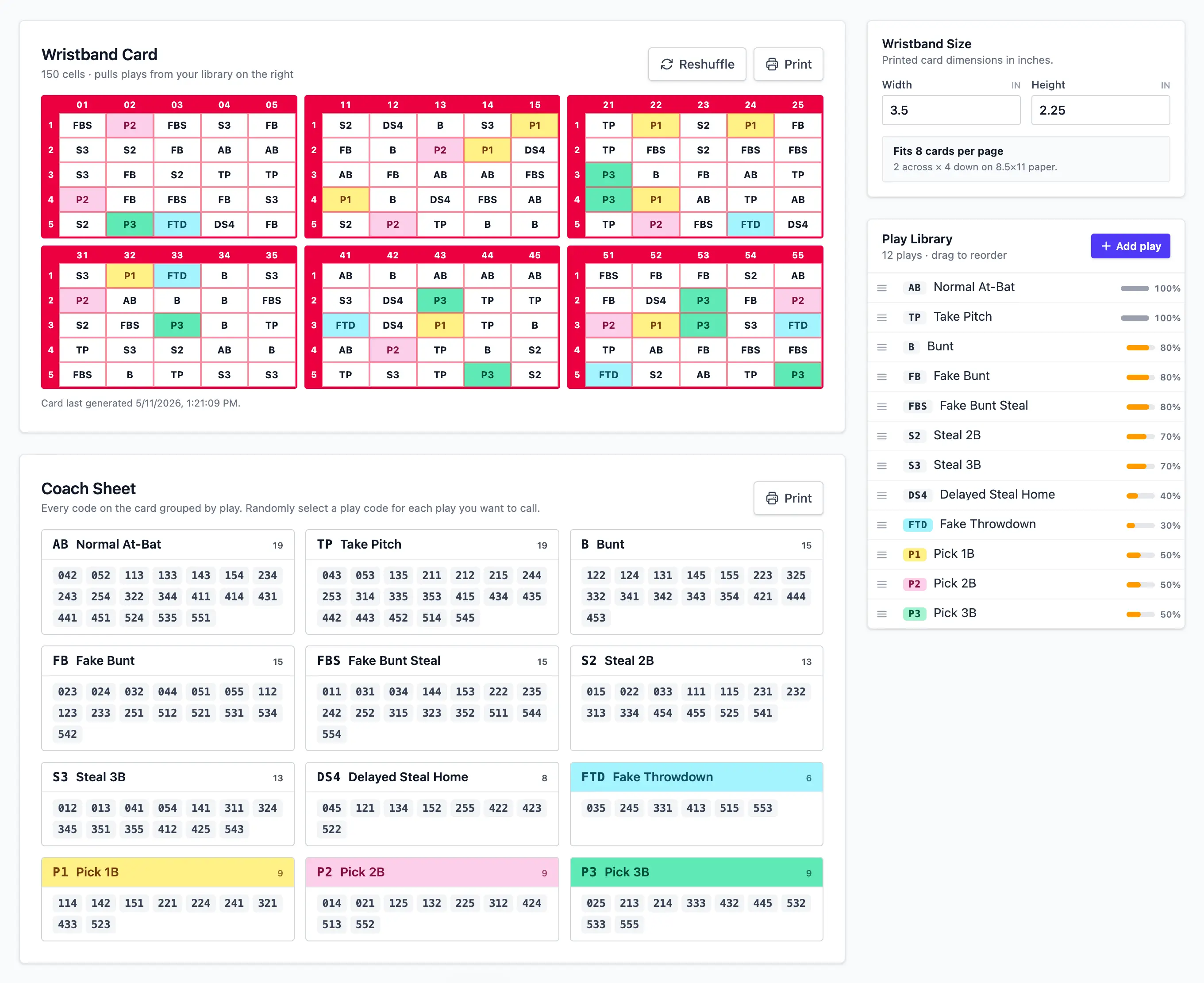
Build a play library. Randomize it onto a number-coded grid. Print one card onto every player's sleeve. Call a three-digit code from the dugout — your hitter reads off the play, the other team has no idea what you said. Each play maps to a dozen different codes, so opposing teams can't crack your fastpitch signs from a single call.
Completely free. No credit card. Prints to standard youth wristband sleeves.
Why coaches are switching
Hand signals are guesswork. Wristbands make sure every sign lands.
Five places where hand signals quietly cost you runs — and how a single printed card solves every one of them.
Communication
A coach miming six body taps while the pitcher winds up. Half the team is still decoding when the ball is in the air — if they were even looking at the right moment.
Coach calls one three-digit code from the dugout. Hitter, runners, and on-deck all read the same play off their wrist in under a second.
Learning curve
Every player has to learn (and remember) your unique code system. A guest player or tournament pickup is useless on offense until you teach her your signs.
The system is the card. A guest, pickup, or brand-new sub can read a wristband call on her first at-bat — no training, no practice reps, no review.
Flexibility
Adding a play means inventing a new body tap, teaching it to twelve players, and hoping nobody confuses it with last week’s. Mid-game changes are impossible.
Add a play, reshuffle, and reprint. The grid scales by adding a row or a column — a new playbook takes five minutes, not a practice.
Security
Touch-your-hat sequences get charted from the opposing dugout. A tournament team cracks the pattern by the third inning and your offense is naked.
A randomized grid has no pattern to chart, and each play maps to a dozen different codes. Reshuffle between games and last week’s intel is worthless.
Guesswork
Coaches invent their own systems, players half-remember them, and every missed play turns into "did she miss it or did I give the wrong sign?" There’s no system — just hope.
Nothing to remember, nothing to guess. Coach calls a code, the card says what to do. It’s a system that solves the entire problem of coded communication — not a tradition that mostly works.
How it works
How softball wristband play calling works
Three steps. Five minutes. One card on every player's sleeve.
- 1
Add Your Plays
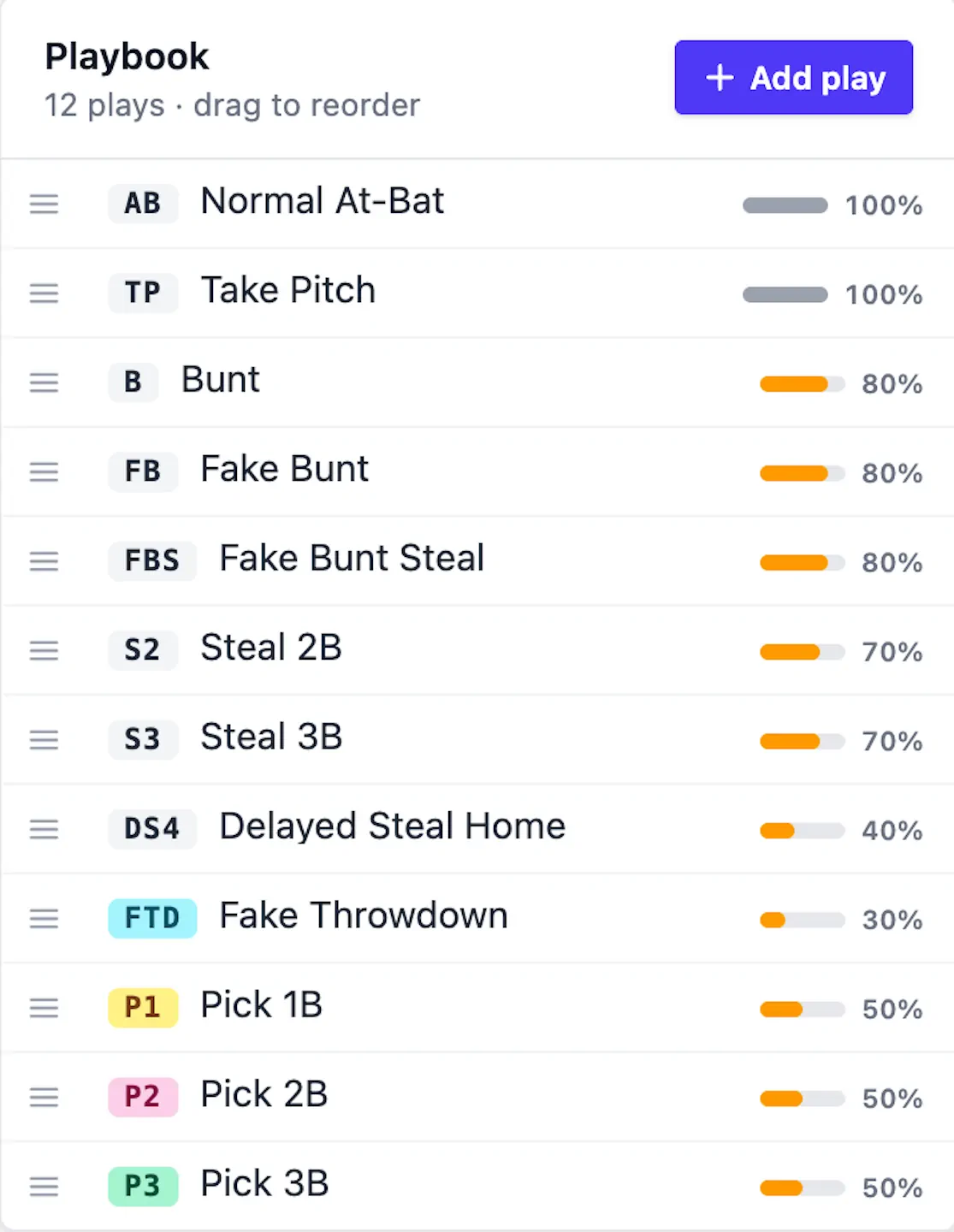
Add every play you want available: bunt, steal, hit-and-run, take, squeeze, slap. Give each one a 2–3 letter abbreviation (BNT, STL, HRN), a color, and a weight that controls how often it lands on the card.
- 2
Print Your Cards
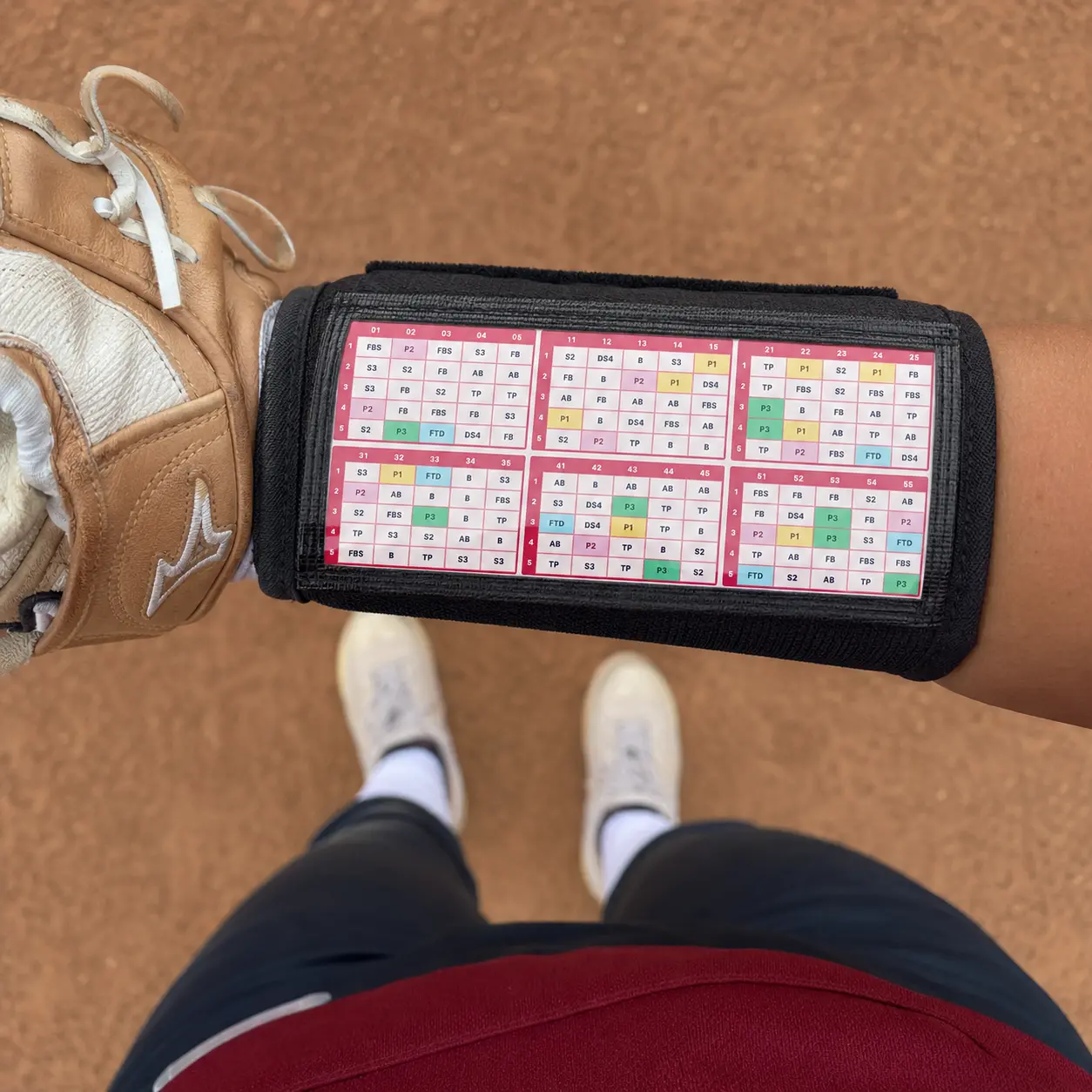
One click distributes your plays across the wristband's cells according to their weights. The same play lands on a dozen different codes. Print eight cards per Letter page and slip them into wristband sleeves.
- 3
Call The Codes
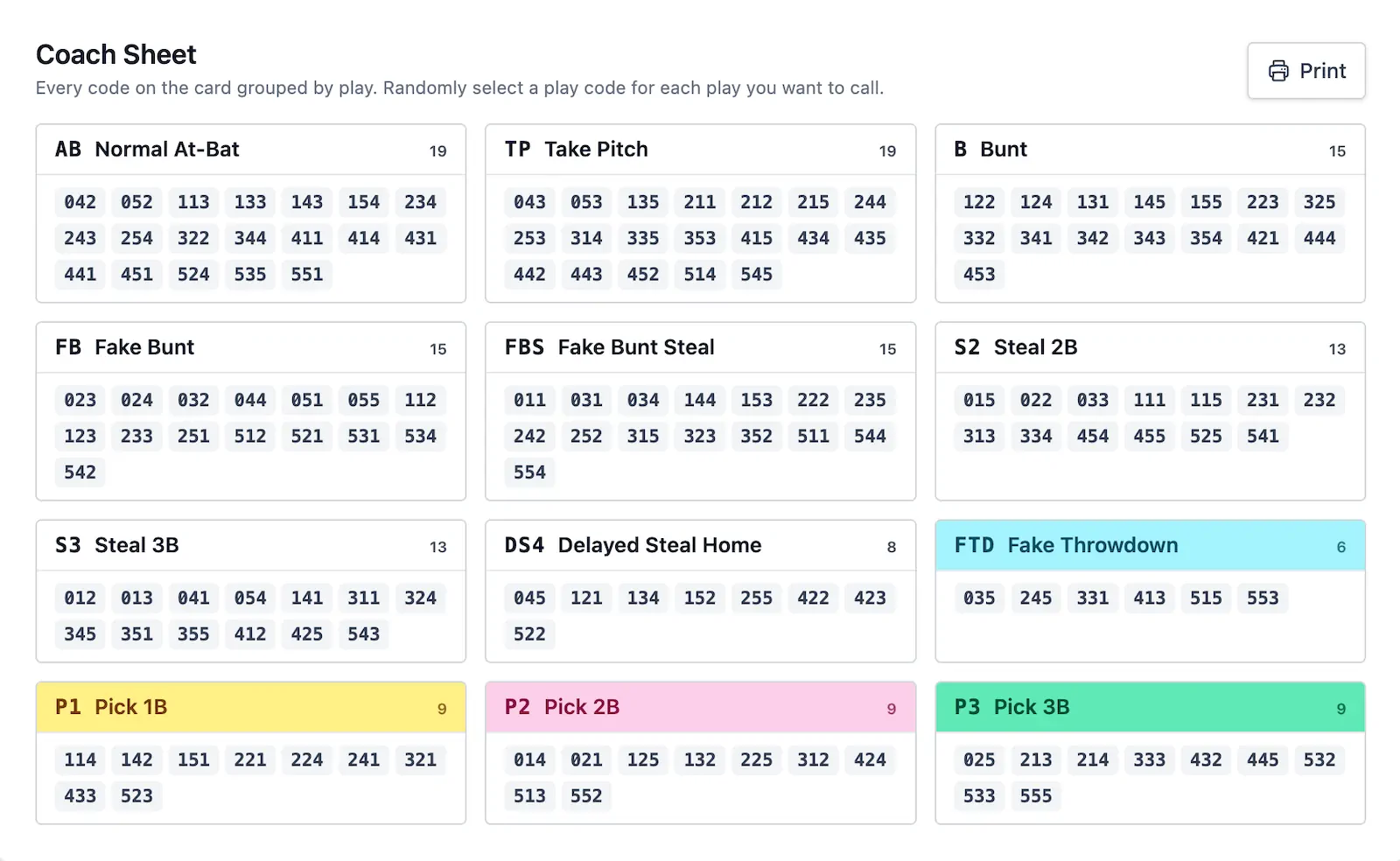
Read the code off your coach sheet — "132" — and call it. Your hitter glances at her wrist, finds the cell, and reads off the play. The opposing team hears the same three numbers and learns nothing.
Inside the wristband builder
Everything you need to call disguised plays from the dugout
Lineupp's softball wristband generator handles the play library, the grid, the coach sheet, and the print layout — without forcing you to leave the app where the rest of your season already lives.
-
Weighted, color-coded play library
Abbreviate, tint, and tune how often each play appears. Heavy hitters (bunt, steal) fill more cells; situational calls (suicide squeeze) show up sparingly. Color survives black-and-white printing.
-
One-tap randomized grid
Reshuffle in a single click. Every game is a fresh deck, which is what makes the wristband steal-proof — last week's codes are gone, so any patterns the other team charted are useless.
-
Matching coach sheet
Every reshuffle regenerates a sheet that maps every code back to its play. Tape it to the dugout fence and call signs with zero memorization. Sheet and wristband always stay in sync.
-
Print 8 cards per page
Default 3.5″ × 2.25″ card size fits standard youth softball wristband sleeves and packs eight per Letter sheet. The sidebar's live readout shows fit count before you print.
-
Resizable for older players
Bigger sleeves for 16U and high school? Bump the card dimensions in the sidebar — the layout reflows and the fit-count updates live so you never waste a sheet of paper.
-
Completely free
No per-card fee, no credit card, no paywall. The wristband generator comes with the whole Lineupp coaching app: roster, lineup, depth chart, schedule, and chat included.
By age group
Softball wristbands at every age level
What you put on the card changes as your players grow. Lineupp scales the grid (smaller cards for younger players, bigger grids for older ones) and the play library scales with you.
Beginner
10U
Keep it minimal so a 10-year-old can read it under pressure. Six plays max, big abbreviations, one or two cell colors.
Intermediate
12U · 14U · 16U
Add tactical depth. Players can handle a longer library and the situational calls that make competitive fastpitch fun.
Advanced
HS · College
Full play calling. Situational packages, alignment changes by hitter profile, "green light" codes for the runner, and double-cross calls.
Why Lineupp
The only softball wristband generator that's part of your whole season
Most softball wristband tools are one-trick generators. Lineupp's is bundled with the rest of the coaching app you'd already want — so your play library lives with your roster, lineup, depth chart, and schedule instead of in a separate single-purpose website.
Lineupp
- Completely free. No credit card or per-card fees. Reshuffle and print as often as you want, every game, every tournament.
- Part of the whole app. Roster, lineup, depth chart, schedule, parent chat, live scoring, and wristbands in one place.
- Coach sheet included. Every reshuffle regenerates the matching call sheet automatically.
- Built for fastpitch. Sized for youth softball sleeves out of the box and fully customizable to fit any wristband; defaults that match how real teams actually play.
Other Wristband Tools
- Per-card or one-time fees ($3.99/card up to $200 flat).
- Building it yourself in a spreadsheet takes hours, and every mid-season edit means re-shuffling the grid by hand.
- No connection to your roster, lineup, or schedule — every coach has to maintain a separate tool just for the wristband.
- Coach sheet is usually an extra step or a separate download.
- Built generically for any sport — not tuned for fastpitch sleeve sizes or softball-specific play vocabulary.
Questions, answered
Softball wristband FAQ
A coach calls a three-digit code from the dugout (e.g. ‘132’). Each cell on the player's wristband has a unique code — column number plus row number — and points at a play like bunt, steal, hit-and-run, or take. It's impossible for opposing teams to decode your calls.
Yes. Paper play-calling wristbands are allowed at every level — Little League, USA Softball, USSSA, NFHS high school, and NCAA. The vast majority of rec, travel, and high school fastpitch teams now use some form of wristband signaling for both offense and defense.
It depends on the age group. 10U-12U usually runs a minimal set: bunt, steal, take, hit-away, slap, fake bunt. 13U-14U layers in hit-and-run, sacrifice, squeeze, and a few defensive shifts. 15U-18U adds situational packages, alignment changes by hitter profile, and ‘green light’ codes. Keep abbreviations to 2–3 characters so they're glance-readable in the box.
Three steps. First, build a play library — name each play, give it a 2–3 letter abbreviation, pick a cell color, and set a weight that controls how often it appears on the grid. Second, generate a randomized grid that distributes those plays across cells according to their weights. Third, print the grid on Letter paper (Lineupp packs eight standard-size cards per sheet) and slip each card into a clear-pocket wristband sleeve.
Practically no, if the grid is randomized. Hand signals get stolen because they follow a repeatable pattern — wristband codes don't. The call ‘132’ points at a specific cell on your wristband but means nothing on the opponent's. Reshuffle the grid between games (it's one button in Lineupp) and you reset the deck entirely. That's why anti-sign-stealing wristbands have become the default at every level of competitive fastpitch.
Lineupp is free and bundled with your whole softball team management app — roster, lineup, depth chart, schedule, parent chat, live scoring, and wristbands all in one place. 3up3down charges per card; Armband Creator and Never Miss a Sign are one-time card generators that don't know anything else about your team. With Lineupp your play library lives with the same account that runs the rest of your season, so you're not maintaining a separate tool just for the wristband.
The default is 3.5″ × 2.25″, which is the most common youth softball sleeve and packs eight cards per Letter page. You can change the card size in the sidebar; the sidebar's live readout always shows how many cards will fit on a sheet so you don't waste paper. Bigger sleeves for older players are one-click.
Yes. Every reshuffle also regenerates a matching coach sheet — one tile per play with every code that maps to it. Tape the coach sheet to the dugout fence or clip it to a clipboard, call codes off it during the game, and you never have to memorize where any play lives on the wristband grid. The coach sheet and the wristband always stay in sync.
How do softball wristbands work?
Are play calling wristbands legal in softball?
What plays should I put on a softball wristband?
How do you make a softball wristband?
Can opposing teams steal your wristband signs?
How is Lineupp's softball wristband generator different from 3up3down, Armband Creator, or Never Miss a Sign?
What size wristband sleeves does Lineupp print to?
Does the wristband come with a coach sheet?

Free for every team
Try Lineupp. It's completely free.
No credit card, no commitment. Lineupp is free for every team, with no paywall or feature gating. Tell us a bit about your team and we'll get you set up before your next practice.
Lineupp
Everything included.
Free for every team. Everything below is included.
What's included
- Unlimited players, parents, and assistant coaches
- Roster, schedule, and practice plans
- Depth chart and defensive formations
- Lineup builder with printable cards
- Live scoring with public scoreboard link
- Dugout monitor for the fence-clip tablet
- Playbook and printable wristband play-call cards
- Team chat with parent and coach permissions
- Film review with YouTube, Vimeo, and direct uploads
- Game-day checklist and snack rotation
- Full CSV export — your data is always yours